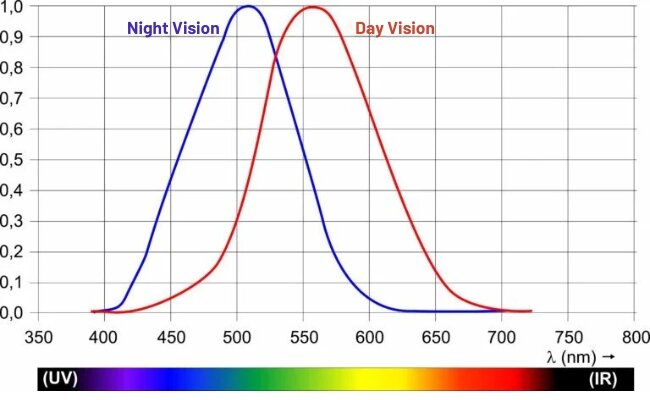
Blindingly bright days and pitch-black nights: human eyes can adapt to enormous differences in brightness, although the retinal cells responsible for night vision cannot distinguish colours. In fact, photopic vision (day vision), scotopic vision (night vision) and mesopic vision (in twilight) function differently.
The difference between photopic, mesopic and scotopic vision
The human eye perceives brightness and colours in different ways:
-
Photopic vision (day vision)
Daylight is detected by the so-called cones in the retina, of which there are three different types for the primary colours blue, red and green. They are specialised for bright light and enable sharp colour vision as well as the perception of fine details.
-
Scotopic vision (night vision)
Night vision is handled by the sensitive rods, which can detect even very faint light stimuli in the dark, but can only distinguish between levels of brightness and shades of grey. Colours remain invisible, and contrasts also appear significantly weaker than during the day. Visual acuity decreases significantly during night vision, so that even in relatively good lighting conditions (e.g. on a clear full-moon night), details are harder to make out.
-
Mesopic vision (twilight vision)
Between these two states lies mesopic vision at twilight, in which both cones and rods are active.
From daytime vision to night vision
The eye requires around 25 minutes to switch between daytime and night vision (dark adaptation). During this process, it must adapt to extremely different luminance levels. As it gets darker, the pupil dilates up to 16 times its diameter at maximum brightness. This allows more light rays to reach the retina. At twilight, both cones and rods are involved in vision.