Solar lights are designed to charge during the day using sunlight and provide atmospheric lighting in the garden or outdoors in the evening. But what happens on cloudy days, in winter, or if the solar lamp receives hardly any sunlight for a long period? The good news is: Even without direct sunlight, many solar lamps can be charged, at least partially.
How does charging solar lights work?
The stronger the sunlight, the more efficient the charging process. Direct sunlight provides significantly more energy than diffused light.
Solar lights consist of
-
a solar panel (also known as a solar module),
-
a rechargeable battery or a standard battery, and
-
a light source, usually an LED light bulb.
When sunlight hits the solar cell, the solar energy is converted into electricity and stored in the battery. This battery then supplies the solar light with energy as soon as it gets dark.
Is daylight sufficient when the sky is cloudy?
Yes, solar lights can charge even in cloudy conditions. However, this happens more slowly and less effectively. On heavily overcast days, several hours of daylight often only provide a limited lighting duration in the evening. After several consecutive overcast days, the battery may not charge sufficiently and the light may fail to come on at all.
Charging in indirect light
Indirect light, such as through a window or on bright days without direct sunlight, can also help with charging. It is important that the solar panel ‘sees’ as much light as possible. Outdoors, therefore:
-
Position solar lights freely, not in the shade
-
Regularly clean solar panels of dirt, dust or pollen
-
Do not position lamps under dense foliage or canopies
Even a thin layer of dirt on the solar panel can significantly slow down the charging process.
Charging solar lamps via USB
Many modern solar lamps offer a practical additional feature: they can alternatively be charged via USB. With a USB cable and a suitable charger, the battery can be charged regardless of sunlight or daylight.
Advantages of solar lights with USB charging:
-
reliable charging even without sunlight
-
quick to use
-
flexible for indoor and outdoors use
This ensures the solar light remains operational even if the sun doesn’t shine for days on end.
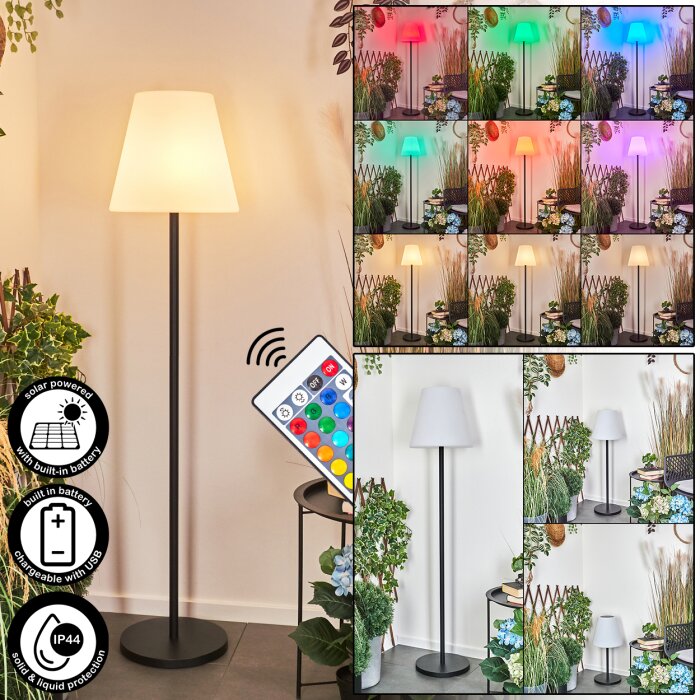


Can solar lights be charged using standard mains power?
Solar lights are generally not designed to be charged directly via standard household mains power. Only models with a USB port or an integrated charging port can be charged using a charger.
Correct usage is important: The battery should only be charged in the manner specified by the manufacturer to avoid damage to the battery or electronics.
Why isn’t my solar lamp lighting up despite being charged?
If a solar lamp still doesn’t light up after more days, there may be various reasons behind this, such as a dirty or damaged solar panel. Particularly after one to two years, it may be worth replacing the battery to restore the light output.
You can find out exactly which steps to try and when it’s worth replacing the battery in the article “Solar light no longer works: here’s what you can do”.
Tips for better charging without sunlight
Even if the sun doesn’t shine every day, a few simple measures can ensure that the solar light still charges reliably and lasts longer:
- Fully charge solar lights before first use
- Clean the panels regularly
- Place lights in the brightest possible location
- Use USB charging during prolonged periods of bad weather
- Bring solar lamps indoors temporarily in winter if necessary
Conclusion
A solar lamp can be charged even without direct sunlight, albeit more slowly and less efficiently. Cloudy daylight can be sufficient to partially charge the battery, especially with modern solar lights featuring high-performance solar modules.
The most reliable models are those with an additional USB charging function, which work regardless of the weather and sunlight. This ensures that light remains reliably available in the garden or outdoors even on dark days.